
In 2025 banks are in for challenges such as pressure on margins and slowing credit growth. With the likelihood of a repo rate cut in February or April, external benchmark-linked loans of banks will be repriced immediately. However, deposit rates are expected to adjust more gradually, which could impact the net interest margin (NIM) - a key measure of profitability for banks.

Most of those punished were managers across different scales, from Scale 7 (general managers) to Scale 1 (officers). However, at least one bank - Oriental Bank of Commerce - revealed that 17 single-window operators (SWOs), five head cashiers, two clerks, one clerk-cum-cashier, and one peon-cum-housekeeper were among those penalised for staff delinquency. Punishments against these employees included withholding of increment, demotion for one year, and censure under provisions of the bipartite settlement.

Former RBI governors Urjit Patel and Raghuram Rajan have also expressed worry about the Mudra scheme, particularly government's target-setting practice and the rising bad loans.

Rs 2.06 trillion, is the gross non-performing assets of Indian banks.

As the fight for deposits intensifies, the cost of money will rise and the margin will be under further pressure, points out Tamal Bandyopadhyay.

The country's largest private lender HDFC Bank's bad-loan write-offs doubled to Rs 3,100 crore in the April-June quarter (first quarter, or Q1) of 2021-22 (FY22), from the level of Rs 1,500 crore in the same quarter of 2020-21 (Q1FY21). It also offloaded its non-performing assets (NPAs) amounting to Rs 1,800 crore in Q1FY22 to maintain a robust asset quality profile. It had jettisoned NPAs worth Rs 1,000 crore in the last quarter. Lenders knock off stress assets from books after making full provisions. Their right to recover dues from delinquent borrowers remains intact after the write-downs.

Bank credit growth is expected to moderate this financial year after a robust 16 per cent estimated for last financial year, driven by strong economic activity and retail credit demand. There are three reasons for this: a statistical high-base effect given the strong growth seen last financial year, revision in risk weights by the Reserve Bank of India (RBI), and relatively slower economic activity.

Private sector banks that announced their earnings for the October-December quarter (Q3) of 2024-25 (FY25) reported a rise in credit costs due to higher provisions, mainly for unsecured retail loans.

State Bank of India (SBI) on Saturday reported 10 per cent fall in standalone net profit at Rs 18,643 crore for the fourth quarter ended March 2025. The country's biggest lender had earned a profit of Rs 20,698 crore in the January-March period of 2023-24.
Bad loans are turning nightmarish for Indian banks.

Banks have written off bad loans worth Rs 10,09,511 crore during the last five financial years, finance minister Nirmala Sitharaman informed Parliament on Tuesday. The non-performing assets (NPAs), including those in respect of which full provisioning has been made on completion of four years, are removed from the balance sheet of the bank concerned by way of write-off, she said in a reply to Rajya Sabha. "Banks write off NPAs as part of their regular exercise to clean up their balance sheet, avail tax benefit and optimise capital, in accordance with RBI guidelines and policy approved by their boards.
Foreign Banks operating in India have outpaced domestic banks, both private and PSUs, in reducing the level of non-performing assets, a study has revealed.

With the price of gold entering a strong bull run, gold-loan non-banking financial companies (NBFCs) are under the spotlight, even though their performance is not directly linked to gold price. Muthoot Finance outperformed in the April-June quarter (Q1) of 2025-26 (FY26), with its assets under management (AUM) growing 10 per cent quarter-on-quarter (Q-o-Q) and 42 per cent year-on-year (Y-o-Y), an improvement of 88 basis points (bps) Q-o-Q in net interest margin (NIM), and a fall in credit cost. Gold AUM rose 40 per cent Y-o-Y and 10 per cent Q-o-Q. The company recorded recoveries of 350 crore, including 100 crore from an asset reconstruction company (ARC), resulting in a 100-bp Q-o-Q yield increase.
The net non-performing assets (NPAs) or bad loans of 40 listed banks jumped by 38 per cent or around Rs 35,424 crore (Rs 354.24 billion) in the first six months of current financial year.

Central Bank of India's 21.5 per cent assets are either bad or have been restructured.

Private banks' net profit grew 26.3 per cent year-on-year (Y-o-Y) to Rs 48,982 crore in the first quarter ended June 2024 (Q1FY25) owing to healthy growth in credit and other income. The gross non-performing assets (GNPAs) increased with the end of dispensation granted during the pandemic, according to the data compiled by BS Research Bureau for listed 18 private banks.
Asserting that the non-performing assets in the banks have been contained, bankers on Tuesday said that they were monitoring it on a constant basis.

On a sequential basis, banks have had to set aside a substantial amount for bad loans, up 30 per cent from Rs 3,459 crore in the June quarter to Rs 4,508 crore.

Commercial banks in India reported a sixth consecutive year of rise in their net profits in 2023-24 while bad loans continued to fall, according to the Reserve Bank of India's (RBI's) annual publication "Trends and Progress of Banking in India", released on Thursday. "Banks' profitability rose for the sixth consecutive year in 2023-24 and continued to rise in H1:2024-25 with the return on assets (RoA) at 1.4 per cent and return on equity (RoE) at 14.6 per cent," the report said.

The RBI has been critical of banks for using restructuring schemes to hide the stress.

Finance Minister Nirmala Sitharman on Monday held a performance review meeting with heads of public sector banks and asked them to make concerted efforts to garner deposits. Deposits have been growing 300-400 basis points lower than the credit growth in the last few months, creating an asset-liability mismatch for banks. During deliberations on the deposit mobilisation, she said that while the credit growth has picked up, mobilisation of deposits could further be improved to fund the credit growth sustainably, and asked banks to make concerted efforts to garner deposits by conducting special drives.

Defying the bearish sentiment in the markets on Monday, ICICI Bank's share price rose by 2 per cent, reaching an intraday high of Rs 1,234.4 per share on the BSE. With a 1.5 per cent gain at the close, the stock emerged as the top performer on both the BSE Sensex and the National Stock Exchange Nifty 50 indices.

The gross NPAs of some public sector banks, including State Bank of India and Punjab National Bank have crossed 4 per cent of the total assets at the end of March, 2013.
The drop in net interest margin will separate the men from the boys, explains Tamal Bandyopadhyay.

'That way you're not hostage just to US sort of exports to India.'

An administrative enquiry is under way to find out why United Bank's non-performing assets had been under-reported.

Largest private sector lender HDFC Bank on Tuesday reported a 34 per cent jump in its standalone net profit to Rs 16,373 crore for the third quarter ended December 2023. The bank had earned a net profit of Rs 12,259 crore in the corresponding quarter of the previous fiscal year.
Finance Minister Nirmala Sitharaman on Monday said that writing off does not mean "completely waiving the amount" and banks follow up on loans to recover the outstanding dues. "Writing off is not completely waiving the amount. As a part of the accounting process, banks make a provision for the amount, which is due from the NPA account and in that process, we call it as writing off, but the provisioning is made and the pursuing of that particular defaulter or the NPA, which owes money to the bank, is followed up," the minister said answering a query in Lok Sabha.

Banks' gross non-performing assets (NPAs) and net NPAs are expected to rise to 10.1-10.6 per cent and 3.1-3.2 per cent, respectively by March 2021, Icra said on Monday. The agency also expects net NPA to decline to 2.4-2.6 per cent by March 2022. "As moratorium on loan repayments is over and though we await the Honourable Supreme Court directive on asset classification, the GNPAs and NNPAs for banks are likely to rise in near term to 10.1-10.6 per cent and 3.1-3.2 per cent, respectively by March 2021 from 7.9 per cent and 2.2 per cent, respectively as of September 2020," the rating agency said in a report.

The meeting will review annual financial performance of public sector banks, credit offtake in the economy, priority sector lending and progress made under various social sector schemes, including Atal Pension Yojana (APY) and Pradhan Mantri Jan Dhan Yojana.
Rush to offload bad loans indicates a revival in asset-sale market

Financial Services Secretary Rajiv Takru said banks were trying to make a distinction between wilful defaulters and those genuinely stressed.
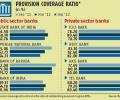
Amid a rise in non-performing assets, most public sector banks have seen a substantial drop in their provision coverage ratio in the year since the reserve Bank of India (RBI) withdrew the 70 per cent provision coverage ratio norm.

NPA percentage in loans may touch 10% by March 2013, up from 5% in March 2011.

State Bank of India (SBI), India's largest lender, reported an impressive 84% jump in its standalone net profit for the December quarter, reaching Rs 16,891 crore. This is a significant increase from the Rs 9,164 crore earned in the same period last year. The bank's total income also grew to Rs 1,28,467 crore in Q3 FY24, compared to Rs 1,18,193 crore in the same period a year ago. SBI's asset quality improved as well, with gross NPAs declining to 2.07% at the end of December from 2.42% a year ago. Net NPAs also eased to 0.53% from 0.64% in the same period last year. On a consolidated basis, SBI Group's net profit rose by 70% to Rs 18,853 crore in Q3 FY24.

FinMin plans tougher targets for bad loans, Casa and others in performance-linked pay for senior management.

While banks are not as exposed as the corporate sector during the initial stage of the pandemic, the strain on lenders could ultimately be profound. Banks face a second-order hit compared with the corporate and household sectors.

The ministry has told the government banks to put the system in place by March 2011.

Gross NPAs of public sector banks were Rs 41,378 crore (Rs 413.78 billion) in March 2006, which came down to Rs 38,305 crore (Rs 383.05 billion) in March 2007 because of better economic environment.
